
Old Molson State Bank building as it looks today
Soon, many mining claims were staked and the town site was platted. Before long, the town’s population reached three hundred. Buildings could not be built fast enough, and many people had to live temporarily in tents. Soon the town had a newspaper, three general stores, an attorney, a doctor, a drug store, three saloons, a dance hall, a livery barn, a blacksmith shop, an assay office, and a three-story hotel complete with a two-story outhouse. The hotel was called Hotel Tonasket, named after the great Okanogan Indian chief.
After Molson’s first boom busted, the Molson Company, having invested a reported $170,000, withdrew its backing, and the population dwindled fast. In June 1901, there were only twelve people living in Molson. By 1903, though people were homesteading nearby, it made little difference in the town, which served as a stopping-off place for settlers moving into the area.
Mining never did amount to much in the Okanogan Highlands. The Buckeye Mine, four miles east of Molson, built a twenty-stamp mill in 1904. This mill had only short runs for two or three summers, and then closed down for good. The Poland China Mine operated on and off for forty years. It had an eight-stamp mill and shipped some ore to the smelter at Trail, British Columbia. This was the only ore ever shipped from the Molson area. The last mining there was done in 1938.

Built in 1900 at a cost of $8,500, it was one of the finest hotels in the county. The 34 rooms were nearly always filled. The rates were from 50 cents to $1.00 and meals were 35 cents. Tonasket Hotel, was destroyed by fire in June, 1924.
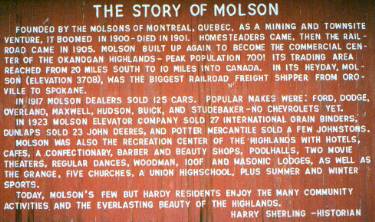
Early in 1905, with the news that the route of the railroad was definitely coming through Molson, things started booming again. In the meantime, J.H. McDonald, who ran a livery barn and stage line, filed on 160 acres for a homestead; that 160 acres included forty acres that the Molson Town Site Company was developing into the town of Old Molson. The Tonasket Hotel and other buildings were already on this land.
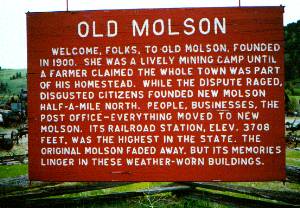
On April 15, 1909, McDonald published a notice for “all persons living or residing or doing business on said tract of land or any part thereof to depart forth with from said land and to stay off.” When it became evident that clear titles could not be obtained, a New Molson was platted near the railroad tracks. Disgusted citizens founded New Molson half mile north of Old Molson. People, businesses, and the post office--everything moved to the New Molson site. Its railroad station, elevation 3,708 feet, was the highest in Washington State. New Molson mushroomed, but the glory was short-lived, as the depression took its toll. The railroad was taken out in the mid-1930s, and New Molson became a quiet agricultural community.
Old Molson faded away, but memories of its old glory days still linger on in those old weathered, worn buildings, where the ghosts refuse to surrender.
In the 1950s, the Molson red brick school, which is now the museum, had an average daily attendance of 110 to 120 pupils. The Molson Museum now maintains a collection of historical materials inside the former schoolhouse. Today, visitors can tour the red brick school museum and enjoy the many splendid exhibits on life in the pioneer days. About two blocks from the old school is another part of the Old Molson Museum. This part of the museum is where the original boom town of Old Molson once stood, and it includes an assay office, a bank building, old homestead cabins, a saloon, a law office, a machine shed with antique farm equipment, a few smaller structures, a windmill, mining equipment, and many other old relics. Everything that should be in an Old West town is here. Mark this historic ghost town down as a must-see place on your trip to Northeastern Washington. Today Old Molson provides a unique glimpse into the past.
Vacant eyes look out onto the deserted streets, and ghosts peer out sightless windows. Wind and sagebrush, and above all, solitude, populate the thoroughfares of yesterday at Old Molson, conjuring the mystique of the Old West.
And of yes, pardner, please don’t leave until you’ve had a chance to sample one of the museum’s fresh-baked homemade pastries with a hot cup of fresh brewed coffee.

Molson, In 1911 the New Imperial Hotel was built replacing the Molson Hotel which burned down in 1910. The New Imperial had 23 rooms and a large dinning room. In 1913 new owners renamed it to the New Wallace Hotel. Then again in 1916 it was renamed the New Molson Hotel. Finally on July 3, 1923 it went up in flames and burnt to the ground.
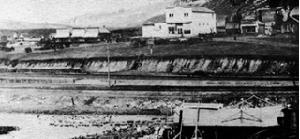
New town of Molson, 1911, view looking across railroad tracks