About eight miles south and slightly west of Conconully is the deserted town site of Loop Loop which was once the scene of more mining activity than any other spot in Okanogan county.

Stephen F. Chadwick was governor of Oregon in 1877-1878. He came to Okanogan in 1888 to plat and promote the town of Loop Loop.( Photo from Okanogan County Historical Society Collection).
Millionaires were produced there in minutes. Loop Loop, which lies only a couple of miles over Ruby Ridge and west of the Ruby townsite, was a flourishing town in its days. As Loop Loop City it was the first town in Okanogan County to be platted, August 14, 1888, by W.P. Keady and S.F. Chadwick. The once bustling mining settlement had eighteen businesses and several streets.
There are no known pictures of the town, but Loop Loop had two hotels, four saloons, ice house, two mercantile, assay station, livery stable, city hall, post office, bath house, harness shop, miners supplies and Ma’s eats. Depreciation in silver in 1893 marked the immediate downfall of the town. The one large company operating there quit and the miners left. Rapidly the lights were extinguished in the place as Loop Loop became a ghost town; the perfect background setting to old west tales and memories of what was.

Loop Loop City as mapped by W.J. Dorwin & Charles H. Ballard in 1892
Businesses in Loop Loop City
The following is a partial list of businesses that were in Loop Loop at one time or another.
Loop Loop Miners Supplies
Loop Loop Saloon
Comstock Saloon
Last Chance Saloon
Lone Star Saloon
Peacock Hotel
Jones Ice House
Macks Harness
Livery Stable
Jones Bath House
Ma's Eats
Loop Post Office
Loop Loop City Hall
Assay Office
Dorwins Hotel
Ballards Mercantile
Jones Mercantile
The Mysterious "China Wall"

The Panic of 1893, a national depression and the Silver Purchase Act of 1890 forced the Government to stop buying silver. The mining boom collasped overnight, work ceased, mining camps were abandoned.
Arlington Mill—that mysterious set of massive granite walls in the Loup Loup country, on the side of Ruby Hill—is referred to by many as the “China Wall.” The great stone walls, up to three feet thick, rise from the heavily wooded slopes of Ruby Hill, the huge blocks of granite tightly fitted and the corners perfectly squared. The largest of the ten walls measures eighty feet long and twenty-seven feet high. The second is seventy-seven feet long and twenty feet high. This massive structure is one of the most enduring and mysterious of Okanogan County’s relics.
Jonathan Bourne Jr., a Portland, Oregon, lawyer obsessed with mining fever, bought a total of twenty-seven claims near Ruby in 1888. Heir of a wealthy New England whaling and manufacturing family and member of Portland’s high-class Arlington Club, he soon had a chokehold on more of the mining district than anyone else did. No stamp mills existed at this time in the area, but Bourne seemed to know that ore would have to be concentrated before mine owners could afford to ship it to smelters far away. Bourne decided to do something about the situation.

Strong-Willed, vigorous and pulsating with ambition, 23 year old Jonathan Bourne Jr., was a key figure in construction of the "China Wall." Courtesy of Okanogan County Historical Society
In 1889, he sent a mining engineer to inspect his claims. The engineer reported no mineral signs in several of his claims, but this made no difference to Bourne. He began to build a brickyard close to the intended mill site. He ordered the production of 400,000 firebricks, to be used for construction of the furnace and steam boilers of the intended mill. To build the massive granite walls, Bourne hired a German stonemason named Chris Stazman. Stazman organized local miners, carpenters, farmers, and others into a workforce that successfully quarried granite outcrops above the mill site. This same workforce skidded granite blocks downhill—some blocks weighing several hundred pounds and others weighing in excess of 2,066 pounds, or slightly more than a ton, each—and built the massive walls using the block-and-tackle method.
During the three-month period of construction of the Arlington Mill, the work employed well over 150 men. The mill was partially constructed during September, October, and November of 1889. It was never finished, however. Jonathan Bourne’s Arlington Mining Company was skidding into bankruptcy. The wooden superstructure was torn down, and whatever equipment had been delivered to the mill site was removed.
Only the massive granite stone walls are left today, victims of miscalculation and of the collapse of the silver mining boom in 1893. The original mining claims that Jonathan Bourne had purchased in 1888 on Ruby Hill—the First Thought and four other claims and mines—became known as the Arlington Mine. This mine had various owners after Bourne had departed. Decreased mining activity shattered any hopes of the Arlington Mill ever operating.
The Arlington Mine was worked briefly in 1905 and again in the early 1920s. In 1936, new owners built a mill at the mine site high on Ruby Hill. There were a total of fifteen or twenty men employed at the mill at that time. In 1937, Jonathan Bourne Jr. was eighty-two years old, living in retirement in Washington, D.C. One might wonder whether Bourne was aware that in distant Okanogan County an Arlington Mill finally had started operating.
Through the years, the massive granite walls have been shrouded in mystery and peppered with speculation. Somehow they have been linked with the Chinese. A number of local pioneers had heard that Chinese were involved in construction of the walls. However, a sampling of the names on the Arlington Mill payroll records does not show any of a Chinese flavor. Nor does it appear that Scottish masons built the walls, which has been one of the most enduring rumors attached to this massive granite structure. The walls and the rest of the Arlington Mill were constructed by the only sort of workforce one might have expected to assemble in the raw, rugged Okanogan County of 1889—miners, farmers, carpenters, masons, common laborers, and drifters. Rising awesomely from the forested hillside of Ruby Hill and the charming Loup Loup Valley, brooding over unfulfilled destiny as the seasons pass, the great granite walls are a monument to history gone by.
The Arlington Mill is located in the Loup Loup area of Okanogan County. The simplest way to reach it is to turn off the Loup Loup Highway (SR 20) onto the Loup Loup Canyon road leading to the Rock Creek campground. This junction is about 8.5 miles from the south city limits of the town of Okanogan. On the way, you will pass the Rock Creek campground and picnic area on your right, both operated by the Department of Natural Resources. After about 7 miles, on your left, will be Antoine Ritchie’s sagging log cabin. You will cross Loup Loup Creek at this point. About 0.3 miles this side of the Arlington Mill is a white post with survey data on it. The granite rock quarry which provided rock for construction of the mill is directly uphill from this post. The massive granite walls are not easy to see from the road. They are about seventy-five to one hundred yards up Ruby Hill (to your right). Please respect the private property in this scenic valley so that others may also enjoy this location. Note: The road from the Rock Creek campground to the China Wall is not maintained. A truck or four-wheel drive is recommended.
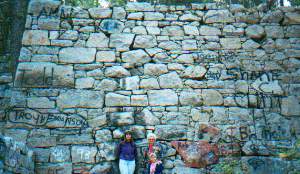
This wall is the largest of ten walls, measuring 80 feet in length and 27 feet high